Sunday, February 10, 2013

iPad Battery

IPad Battery


The battery used in an iPad is a lithium-ion battery. Lithium is the element of choice in this case because it is highly reactive, meaning a lot of energy can be stored in its atomic bonds. All of this energy is what allows us to play games, search the web, read books, and utilize all of the features we have on our iPads without the battery losing its charge too fast. The word ion is very important to recognize when talking about these batteries because it has both positive and negative charges stored inside of the cell, and they are unbalanced. When remembering the "mountain" image, it's easier to understand why in the battery, the lithium ions move from the negative electrodes to the positive electrodes (because electrons move "up the hill" towards the positive ions, and this creates energy(before this process happens it is just potential energy among the cells).
(A picture of the path of the protons/electrons)

As shown in the picture below, when the ipad battery in plugged into the charger, the ions are moving from the positive side(cathode) to the negative side(anode). This is happening because carbon has a negative charge, lithium has a positive charge, and opposites attract. When the battery is removed from the charger, the lithium moves back to the positive side of the battery. All of this happens at a higher voltage than most other batteries, allowing us to have such a long battery life when using our iPads because the more voltage, the more potential energy, and the more potential energy, the more active energy being put to use in our iPads.


This is a helpful video to understand how the battery works. Although in this case it shows the battery being put to use in a car, it is the same idea with and iPad.


http://electronics.howstuffworks.com/everyday-tech/lithium-ion-battery.htm
http://electronics.howstuffworks.com/everyday-tech/lithium-ion-battery1.htm

Projectile Motion

Projectile Motion


       In this week's lab we analyzed projectile motion. We did did this by throwing a basketball into the air, and as soon as it left our hands it became a projectile. Because the main idea in this lab was forces in two dimensions, we analyzed both the x(horizontal) and y(vertical) dimensions of the ball. After doing this we concluded that in the x direction the only force acting upon the ball is gravity(a downward force), and that the the ball is moving at a constant speed horizontally in the x direction but not in a constant direction. When we analyzed the ball in the y direction we were able to see that it was accelerating but constantly slowing down.

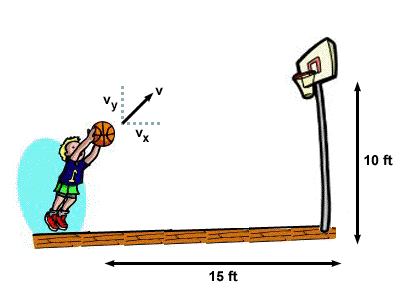
Here is a visual of the force acting upon a projectile-GRAVITY

(disregard the interaction between the person and the earth)

X-Dimension


This velocity-time graph shows the velocity of the basketball in the x direction. After analyzing the graph with a best fit line, we can see that the slope is zero, meaning that the x-velocity is constant.


In this position-time graph we can see that the position of the basketball in the horizontal direction is changing at a constant rate from its initial position.

Y-Dimension


In this velocity-time graph we can see that the velocity of the ball in the y-direction(vertically) is always accelerating at -10m/s^2 (we get this from the slope) from the initial velocity.


In this position-time graph we can see that the position of the basketball in the y direction(vertical) is in the shape of a parabola because that is literally the path the ball takes in the vertical direction.


Sunday, January 13, 2013

Forces in 2D and Circular Motion (Hover Disc)


What does it mean to analyze forces in 2D?
To get a better picture of what a 2D force is, it's easier to know that the sketch of a 1D force is simply a line. So to get a 2D force you must add another line, and when you add this other "line" or another dimension, your force now had length and width. The length and width are represented on the graph by the x and y axes.

How do forces cause objects to move in a circle?
Forces Cause objects to move in a circle through centripetal force. To better understand this process, it helps to know the centripetal means "center-pointing." So while the object is being pulled toward the center through tension force, because it is going at a constant speed, but also accelerating, it remains in a circle. This may sound confusing, but we learned that acceleration doesn't just mean a change in speed, it can also mean a change in direction. So because our object is moving at a constant speed but also changing direction, it is accelerating.

What does it mean to be in orbit?
To be in orbit means when one object follows a "curved path," or moves in a circle around another object, while also being acted upon by centripetal force.

How do satellites orbit planets?
In order for a satellite to successfully orbit a planet, it must be going at the correct constant speed. The satellite is being pulled in toward the planet through gravity. When the satellite reaches its correct speed, centripetal force kicks in to keep the satellite from falling towards the planet, because as weird as it may seem, satellites are always falling. In the lab, when we kept the hover disc moving at a constant speed it's motion remained in a circle. If we were to slow it down, the disc would move in to the center towards us, and we were to speed the disc up we would eventually lose control and it would fly off.

How do planets orbit the sun?
Planets orbit the sun because the sun is the centripetal force acting upon them, very similar to  how satellites orbit around the planets. So each of the planets are falling, and want go in a straight line, but it is the gravitational pull that is preventing them from doing that. So don't ever let anybody tell you there is no gravity in space! And again because their direction is not constant, the planets are accelerating around the sun. Because both the sun and the planets are curved, the planets are falling around the sun, but missing it's surface as it moves in a circle.


Sunday, November 18, 2012

Newton's Laws

Newton's Three Laws of Motion


Newton's Three Laws:

First Law: An Object at rest or in motion will continue to be that way unless acted upon by an unbalanced(net) force.

Second Law: Force=(Mass)(Acceleration)

Third Law: For every action there is an equal and opposite reaction


Hover Disc Lab


Purpose: The purpose of this lab was to help us better understand Newton's First and Third laws of motion.

Background: Before starting this lab we learned about all of the forces in nature that can explain and predict what we observe in the universe.
    • Gravitational - Fg - two objects have mass
    • Normal - FN - electrons on the surface of atoms repel
    • Friction - Ff - electrons on the surface of atoms are shared
    • Tension - Ft - electromagnetic bonds are stretched (rope)
    • Spring - Fs - electromagnetic bonds are stretched/compressed (spring)
    • Buoyancy - F- fluid molecules repel on/in liquid

Procedure: We completed this experiment in total of 10 trials. For the first few trials, we turned the fan on to eliminate friction between our object and the ground. Then for the last few trials we  turned of the fan, making Friction for a factor in our experiment. We did a variety of things, but mostly we either had person 1 or 2 push the disc or stop the disc, or we just let the disc move at a constant speed by itself.


Data: We used two different types of diagrams to interpret our data, Interaction diagrams and Free Body diagrams. Interaction diagrams allow us to see the different types of forces between all of the the objects in our experiment, and a free body diagram allows us to see the forces acting on one of our objects...in this case our disc.

Hover disc is ON. Disc is at rest. Disc had not been pushed.


Hover disc is OFF. Disc is being pushed by person 1.

Hover Disc is ON. Disc is being caught by person 1.


Conclusion: From all of this data, we are able to prove Newton's first law, that an object at rest or in motion will continue to be that way unless acted upon by an unbalanced(net) force. We also prove Newton's third law, that for every action there is an equal and opposite reaction(using the same force). We observe this when the hand stops the disc from moving. Both are exerting normal force, but they are moving in opposite directions.

Real World Connection: Air Hockey

Air hockey is a perfect example of Newton's First Law.In the game of air hockey you have a puck, handles, and a table. The air coming up from out of the table eliminates the friction between bot the puck and your handles. If you were to leave the puck and handles on the table while the table was on, the puck and handles would continue moving at a constant speed forever(or at least until the table's batteries ran out). When you hit the puck with the handle though you are creating a net(unbalanced) force, therefore causing the puck to accelerate.


Fan Cart Lab


Purpose: The purpose of this las was to better understand Newton's Second Law and the relationship between mass, force, and acceleration.

Background:  1) Acceleration is a change in velocity over time
                         2) Acceleration is the slope in a velocity 
Procedure: We had a track with a sonic range finder on one end and a force probe with a metal ring attached to it on the other end which was hooked up to the computer. We completed a total of 5 trials, and for each trial we increased the mass of our cart by adding brass masses.

Data: In order to find the acceleration of our fan cart we measured the slope, because acceleration= the slope. We also analyzed our data using liner fit(y=mx+b) because we were finding the slope.

Here are two examples of our graphed data:

Mass=.5kg - Acceleration=.3773m/s^2


Mass=1.3kg - Acceleration=.1372 m/s^2


After we got the results for all 5 trials, we tried to derive an equation from our data.


Equation Time!

Fnet= m(a)
  • F= net force
  • m=mass
  • a=acceleration 

Analysis: From our data we were able to conclude that net force equals mass times acceleration, and that mass and acceleration are inversely proportional (as the mass increases the acceleration decreases). We also were able to understand the concept of net force, and that unless an object has a net(or unbalanced) force, the object will not accelerate.So an object's acceleration depends on it's mass and the net force it experiences.

Real World Connection:

This lab can be connected to something a lot of us do regularly, and one of my absolute favorite things to do...grocery shopping. If we were to push our cart several times(with the same amount of force) and each time add more mass(more food) to our shopping cart, as our cart's mass increased, our acceleration would decrease each time.





Sunday, October 28, 2012

Impulse Lab

Impulse Lab


Purpose: The purpose of this lab was to measure the impulse of an object, which is another way of looking at the change in momentum in terms of change rather than total. We also wanted to determine what the relationship was between impulse, force, and time during a collision.

Procedure:  We took our red cart with an aluminum ring attached to it and crashed it into our force probe, also with an aluminum ring attached to it. This created a collision, which made it possible for us to measure impulse. This data was recorded onto the Graphical Analysis application on the computer.

Data: We calculated the velocity before and after the collision by measuring the  mean of both. 


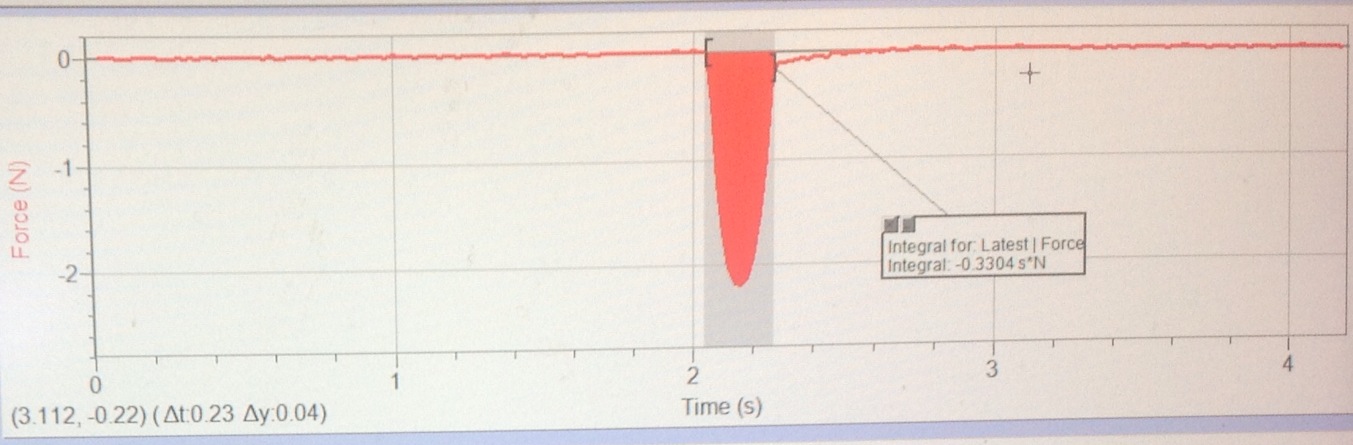
Then the computer calculated the area of the Force Time Graph


Results: 

  • Velocity Before: .551m/s
  • Velocity After: -.495m/s
  • Area of Force Time Graph: -.3304s*N
  • Momentum Before: (.25kg)(.551m/s) = .138J
  • Momentum After: (.25kg)(-.495)= -.124J

  • IMPULSE= -.262 kgm/s

Data 2: With all of these calculations we are able to measure the percent difference


Percent Difference= 23%


Equation Time!


Analysis:
  • In a collision impulse is conserved (it remains constant) 
  • Impulse is Equal but Opposite (inversely related)
  • If you add more time in a collision, your force will decrease (and vice versa)
  • Newton's 3rd Law: For every action, there is an equal and opposite reaction

Real Life Connection:

Airbags: 


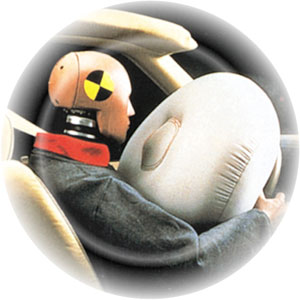
  • The importance of airbags are so stressed because in a car crash, and airbag can save your life. The airbag relates to impulse, force, and time because it slows down the rate at which you collide with an object and stop. The airbag adds more time to the collision and therefore it decreases the force, because the two are inversely related.

Arms in a collision:
  • Something as simple as holding your arms out when you collide into something can make the collision less harmful. When you hold your arms out it acts as a barrier between you and the wall, and also makes it take more time for you to collide into the wall. Because you are increasing your   total time in the collision, you are decreasing the force of your collision.


Sunday, October 14, 2012

Collisions Lab

Collisions Lab


Purpose: The purpose of this lab was to better understand the difference between elastic and inelastic collisions, and what affect each had on the vector and scalar quantities, specifically momentum (vector) and kinetic energy (scalar).

Background:                                         Scalar vs. Vector:

Elastic vs. Inelastic


Procedure: We put two carts (red and blue) of equal mass (.25kg) on each side of the track. We also put two range finders on each end of the track to measure each carts velocity. To record our data we plugged the range finders into the force probe and the force probe into the computer. By doing this we were able to easily measure the velocity (on the graph) of both carts before, during, and after the collision took place. First we did an elastic collision and pushed our red cart(with the spring out) to the right towards the blue cart(also with the spring out). After this collision took place both cars continued to move to the right, but the red cart followed the blue cart at a much slower speed. The next collision we did was an inelastic collision, and again we pushed the red cart to the right toward the blue cart. After this collision though the two carts stuck together (because of the velcro) and both continued to move to the right together.

Data: We then measured the velocity, momentum, and kinetic energy both before and after the collisions. Then we added the two(before and after) together to find the totals of all three of these things.

 Then we found the percent difference of both momentum and energy.


Elastic Collision:


Inelastic Collision:


From this we were able to find the momentum is better conserved than energy(smaller percent difference=less energy given off during a collision). Also that more energy is lost in inelastic collisions than in elastic collisions.

Equation Time!

Momentum: 

P=mv

  • P=momentum
  • m=mass
  • v=velocity

Percent Difference:

(Total Before-Total After)/ (Total Before+ Total After/2)(100)

Real Life Connection:

The concept of momentum in collisions relates to the game of pool. You exert a certain amount of force (using the pool stick) on the white ball. The white ball then (if you actually have an accurate shot) hits one of the colored balls. When it collides with colored ball the colored ball bounces off of the white ball and hopefully into the pocket. This is more of an elastic collision because the white ball does not stick to the colored ball, but still moves in that general direction most of the time.


Sunday, September 30, 2012

Rubber Band Cart Launcher Lab

Rubber Band Cart Launcher Lab


Purpose: The purpose of this lab was to determine the relationship between energy and velocity.

Procedure: We attached our single banded rubber band to the air track, launched our glider with the rubber band, and our velocity was measured by the Photogate Censor. Each time we did this we increased the distance we pulled the rubber band back by .01 meters, and for each distance we launched the glider twice for more accuracy. We used five different distances, with our final distance being .05 meters, so we had a total of ten launches.

Data: Stretched distance, trial 1 and trial 2 velocities, average velocity, squared velocity, and energy

From this we came to the conclusion that energy and velocity are directly proportionate. Each time we increased our energy/(distance), our velocity increased as well.

We then plotted our points putting velocity(m/s)^2 on the x-axis, and energy(J) on the y-axis. This meant that our Independent Variable(IV) is the velocity or the glider, and the Dependent Variable(DV) is the energy used to launch the glider. Using the Graphical Analysis App we used a best fit line to interpret our data and came up with a slope of .258. 

LOL Chart: We discovered a different way to interpret our data and the transfer of energy by using a LOL chart. When you pull back the rubber band, the energy in the rubber band becomes potential energy, when you release( using the rubber band and the glider), the energy becomes kinetic energy, allowing the glider to move. 


Equation Time!

Because of glider was .4kg and our slope was about .2kg we were able to determine that the slope of our line was half the mass of the cart. Using a best fit line to evaluate our data, we modeled our linear equation off of y=mx+b(but b=0 so it cancelled out).

Kinetic Energy Equation:

K=1/2mv^2
  • K= Kinetic Energy
  • m=mass
  • v=velocity squared
Real World Connection!


One real world connection doesn't involve any machines at all, just you and a ball. I have played softball for many years and have been taught to use correct form by all of the coaches I have played for, and over the years this has allowed me to increase the speed and distance I can throw the ball. What I have learned that the further you pull your arm back, the faster and farther the ball will go, so when you increase the distance, you increase the energy you out behind the ball, therefore increasing it's velocity too.